
Opinion: The Gatsby Retelling – Popular Drama “Gossip Girl”?
Hi, I’m Rachel! The Great Gatsby is one of my favorite novels, perhaps even my favorite novel. As a Netflix user, I’ve seen the popular teen drama Gossip Girl and noticed quite a few very specific connections between the two shows. This leads me to believe that Gossip Girl is really a retelling of the famous American novel, and these are all the major connections I’ve noticed thus far.
My qualifications: I’ve read The Great Gatsby three times and analyzed it in Marxist and feminist lenses in high school English classes. I’ve seen both Gatsby movies (1974 and 2013). I’ve seen the 2024 Broadway musical and the 2025 ballet tour. All this to say, I’ve thought about the book a lot. I think it’s beautiful, and it’s a key figure in American literature. I love the messages the book tries to send, and I love how deep each character is. So let’s explore them:
Daisy is the “Golden Girl”. This is perhaps the easiest stereotype to see. Upon first glance, she seems like she is floating in a room full of white lace and curtain. Her voice is full of money, she sounds like chiming bells. Everyone misses her so dearly back home. She’s paralyzed with happiness. However, Daisy is potentially one of the most problematic characters in the story. She cheats on her husband, almost breaks off her marriage, murders a woman and walks away with it. Many people believe Daisy is morally flawed, but I disagree – I believe Daisy is simply doing her best to exist in the context and environment she is in. She had no choice but to stay secure in where she was with Tom.
Let’s talk about Tom. Tom is what I would call under-understood. Not exactly misunderstood; he is an asshole from all angles, as intended by Fitzgerald. But there’s more to him that what the 11th grade unit might suggest. If you analyze Tom and his lineage a bit deeper, Tom is not old-old-money. That is, his family made their fortune in the Midwest, not in New England, which makes him inferior. In the US, the families that had the longest bloodline of wealth were from New England. These are the “bluebloods”, what’s left of the aristocrats from the pre-independence era. They’re the original American Dream realizers, who made their fortune off of banking and trade in the 18th century. Tom is from the Midwest, which means his family made their name in the 19th century. The Buchanan name ranks lower on the social ladder than perhaps the Rockefeller or Morgan name. Now that Tom has moved from Chicago to New York, he is no longer at the “top of the food chain” in the current realm. This makes him feel insecure. This is key. All his rash, disrespectful actions are part of his compensation for this insecurity: He’s always parading around on his polo ponies and buying things performatively. He cheats on Daisy with lower-class women, always lower-class women, because it makes him feel like he possesses them, given the margin in wealth. However, he punches Myrtle when she mentions Daisy because he can’t bear the thought of losing social status. After all, we see the Buchanans retreat into their money at the end of the story. There was always going to be another maid, another Myrtle, that Tom runs around with, but he will never leave Daisy. He holds on tight to her.
Nick is the “morally oriented” narrator, though many of us debate over how “moral” he really is. Does his “morality” belong to his ego only, or is he really a better person than everyone else in the story? After all, he does help to facilitate Gatsby and Daisy’s first meet-cute in New York. He is as much of a character in the story as a narrator. How accurate is his storytelling; is he glazing Gatsby more than he should? How responsible is he for the tragedy that resulted?
I believe Gossip Girl is the modern version of Gatsby, fully played out beyond the premature deaths. As a disclaimer, I have never read any of the books; I have only watched and completed the show. The fact that Dan’s favorite author, that his greatest inspiration, is Fitzgerald, is all the hinting I need. Also, the fact that The Great Gatsby and Gossip Girl share the initials GG? Come on. This can’t be a coincidence. Although it’s not confirmed that series author Cecily von Ziegesar named her series GG to match the classic American novel, I highly doubt that the similarity is a mistake. Let’s see just how similar the story and characters are.
Serena, who is clearly described as the “Golden Girl” early in the series, seems almost like a modern(ish)-day Daisy. She’s messy and impulsive – just like the Daisy that almost ran out on her marriage. At times, our Golden Girl impulsively chooses the risky and exciting option, but ultimately always returns to the safe option. Just as Daisy had her fun with Gatsby, Serena is out blowing up peoples’ lives. She has many affairs throughout the show, most notably with married politician Tripp Vanderbilt and boarding-school teacher Ben Donovan. It seems every two episodes she has a new exciting, fleeting lover that keeps her entertained and giddy in love, but are gone after, well, those two episodes. Serena and Daisy are both criticized for being impulsive and always incurring consequences that they always manage to get out of. Obviously, Daisy’s killing of Myrtle, and Serena’s constantly getting out of expulsion, arrest, and every scandal under the sun.
Still, Gatsby dreams of being with Daisy, and Dan dreams of being with Serena; they both have an infatuation about them. Think the “her voice was full of money” scene. The only difference is that, while Gatsby constantly gaslights himself out of seeing Daisy’s flaws, and dies before realizing that their love was doomed, Dan actually is with Serena long enough to realize her flaws, and resents her and her world for it.
Who is Blair’s analogous character in The Great Gatsby? One might assume that she’s the modern Jordan Baker, the sassy, hip, somewhat deceiving woman that leads Nick on, but eventually retreats into money the same as Daisy and Tom. However, Blair is meant to be Tom, which makes a lot of sense if you look at Tom and why he is the way he is.
This is where the context I provided becomes key: Tom does not belong to the highest class of wealth. When he moves out to New York, he feels like his lineage is inferior to the true bluebloods and old-old money. The same goes for Blair. Her family, the Waldorfs, are not on the same level of wealth as the van der Woodsens, the Basses, or the Vanderbilts. Exact numbers don’t matter too much, but it is implied that the Waldorfs are only worth a few hundred million while the Basses and van der Woodsens are worth billions. Just as Tom compensates for his insecurity by screwing around with lower-class women, Blair compensates for her insecurity by belittling other girls at school, by turning up her nose at everyone else, and being overly focused on social class. Blair is clearly the most classist character in the show: she frequently insults anyone for showing a smidgen of lower-class behavior, treats help badly, and overall asserts her dominance in any way she can. She’s insecure. That’s the reason why. Just like Tom, she knows her lineage is not as powerful as that of those around her, and she has to make up for it somehow. She has to make herself feel superior somehow, which is why she terrorizes girls at school and delivers the most classist comments and behaviors in the show. The fact that both Blair and Tom come from slightly less powerful lineages and feel the need to compensate by asserting superiority is nuanced connection between the two characters.
Those two comparisons were quite simple, but with Dan Humphrey, things get quite complex. It makes sense that Dan would be the Jay Gatsby of Constance-St. Jude’s. He’s the man on the outside looking in, yearning to be a part of higher society, longing for the Golden Girl. Gatsby created a plan to move up the social ladder, and Dan shoved his way into the Upper East Side through his scholarship at St. Jude’s and pure luck, as it seems in the Gossip Girl book series. Dan and Gatsby both came from humble beginnings, but to be with the Golden Girl they yearn for, must assimilate into higher society. While Gatsby truly wants to integrate into the higher class, Dan prides himself on being morally superior to the Upper East Side families. He prides himself on being less corrupt, less consumeristic, less traitorous to friends. However, Gatsby takes some far-out measures to reach the higher class, and Dan in the TV show also does a bit of manipulating for his “dream girl”. This just goes to show: You can’t move up the social ladder without cheating your way up.

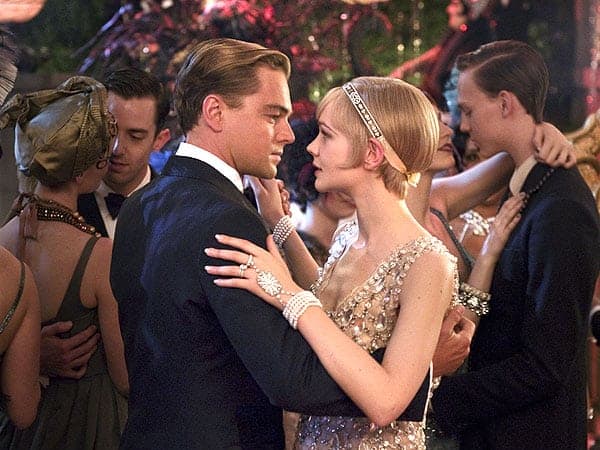
If we are simply looking at the book series’ telling of the story, it ends exactly like Gatsby. Although Dan doesn’t face a sour murder, he ends up exactly where he started, on the outside. His and Serena’s worlds were too different to be together. This is, word-for-word, the takeaway of Gatsby. Systems stay in place; they don’t get overridden. Not love, not hard work, no cheating of the system could ever change class structure. It’s sad, but it’s simple.
However, if we look at how the TV show ended, it’s much more complicated. Upon first glance, it might seem like a happier ending – the kid on a scholarship from Brooklyn marries the Golden Girl of the Upper East Side. I would tell a middle schooler “Dan is Gatsby”. But when we look at how the TV show ended, we need to question Dan’s entire character. It’s not so simple.
The show wrote Dan Humphrey as the true Gossip Girl all along (granted, with plot holes, but with reason nevertheless). Dan didn’t become part of the Upper East Side by chance – he would’ve been easily forgotten as one of Serena’s exes as soon as they broke up, wiped from all Upper East Side status books when Rufus and Lily got divorced, but he wasn’t. He was a main character in the story, but only because he wrote himself into it. He realized early on that “you are only someone if people talk about you”, and by talking about himself, became one of the watched, discussed, key characters. Meaning, in a way, Dan Humphrey is also Nick Carraway. However, while Nick is somewhat of a side character in the story that he writes, Dan is the main character. It’s as if The Great Gatsby were written not by Nick Carraway, but instead by Gatsby himself. Can you imagine that? In the show, Dan basically gets to write his own story, if he frames and manipulates the plotline correctly. Basically, he’s Gatsby if Gatsby could kinda-sorta control the plotlines. Now, can you imagine that? The Great Gatsby written by Gatsby himself, where Gatsby can control the narrative; the plot; the perception of people; fake scandals; what is seen; what is not. Gatsby’s story would be so emotional, and so intense! I don’t think we could handle that. That book would certainly be much too intense for high school curriculum.
My point is, it’s not fair for Dan to have this much power. His role as Gossip Girl makes Dan the most powerful character in the unfolding of the years of the show. He’s more powerful than any of the other teenagers; more powerful than Serena, than Chuck, than Blair. He gets to write how people perceive them, and it’s a scary amount of power. It never really sat right with me that Dan and Serena ended up getting married in the show because it seemed like Dan wrote in that ending for himself, through years of manipulation via a teen gossip site.
That’s all I have for today. This is a pretty dense connection between the classic American novel and soapy teen drama. I’ve had these connections on my mind for a few months now, and kind of wanted to just put it all together. This blog post will be a lot longer than most, since this stuff has been fermenting in my brain for a while. As always, this is just my own interpretation of how the two literary pieces work together, and nothing is “wrong” or “right”. (Though I do believe that both of them being called GG canNOT be an accident.) I hope you enjoyed this take!
Entry #2 – First published 02/04/2026 by Rachel Chen
Use of AI: I asked AI some questions about how the Gossip Girl book series unfolded, since I have never read it myself. I wrote the first draft completely own my own. I asked AI for some feedback, and personally modified my draft after. No sentence in this article was AI-generated.